How Do Elections Affect Investing?


Election years are exciting, but for many, there are fears and concerns about election outcomes. Should we change our investing based on these elections? What if this party wins or the other? How do elections affect investing?
Today, we want to talk about a few different things.
- A principle of investing that I think we need to keep in mind as we discuss elections and how they affect our investing.
- We want to talk about what the government can and can’t do as I think some people think that there’s more to it than there really is.
- Then, of course, we want to look at the effect of elections on equities. And then finally, the effect of political parties on performance.
- Lastly, be sure to stick around to the end, where I give you some of my personal thoughts on politics, which I know you want to hear or at least are curious about. If you’re a client, what does Freeman exactly think about politics?
We Invest in Companies, Not Governments
First, here’s a primary principle we need to remember when we’re discussing elections and their effects. That is, we invest in companies, not governments, right? We are co-owners of the best businesses in the world. And we don’t invest in the nebulous stock market.
We are business owners.
These companies employ the best people. They have the best leadership teams and the best employees. They offer the best services and products, and those leadership teams are always going to make decisions to maximize long term profits, regardless of who’s elected, regardless of who’s in office, right? It doesn’t matter, because we don’t invest in the government. We’re investing in these businesses, and regardless of who’s in charge, whether they’re elected or they’re in charge for four or eight years, they’re going to work to maximize those profits, and we, those who follow my teachings, and clients of mine, right?
Again, we don’t invest in governments. We don’t buy treasury bills. We invest in businesses, and in a free market like the one we live in, companies are affected but not controlled by the government, right? And so yes, there is some effect of elections, some effect of governments, on our businesses, but ultimately, they’re not controlled by them.
How the Government Affects Financial Planning
So how does the government affect our businesses? How does it affect our financial planning? That’s the next thing we want to look at. How does the government affect financial planning? I think there are some misunderstandings about what the President, in particular, and the government, in general, can and can’t do. I’ve heard things from people like, well, when Trump gets reelected, he’ll fix the interest rate problem. Or when Kamala gets elected, she’ll fix inflation. Or when x gets elected, the market’s going to crash, or when x gets elected, the market’s going to surge. Here’s the thing, what does the President actually control? How much of this is in their power?
Does the President Control:
Stock Market Results. No.
The president alone has little effect on stock markets. The government acting together can intervene (bailing out companies/industries, stimulating economies). The outcome of congress is more important than president regarding stock market. More on this later.
Interest Rates? No.
Interest rates are controlled by the Federal Reserve in response to economic conditions. The FED is not controlled by congress/president, for good reason. Anyone who tells you that a president will fix/ruin interest rates is naïve.
Inflation? Not Directly.
Major policies can spark inflation. Congress sets the law; the president approves or Vetos. The Fed quashes inflation through interest rates.
Taxes? Yes, with Congress.
Congress creates a tax bill that the president approves. Taxes affect individuals. They affect businesses, which can alter returns in the short run.
The Government Indirectly Affects Your Financial Planning
Your equity returns are the largest wealth builder: unaffected by the president.
Interest rates affect your fixed income returns. They are a lagging response to economic conditions. Not controlled by the government.
Inflation is the principal problem retirees face. Episode 2. Cost of everything you want/need to buy will double or triple in retirement. The difference between double and triple may be influenced by the government, but not controlled.
Taxes are the government’s biggest effect on your financial planning. I’m much more interested in the election’s outcome regarding taxes than stock market performance. You should too.
The Effect of Elections on Equities
What is the effect of elections on equities? That’s what we want to know, right? Do they affect investing? This is what you’ve been waiting for. It took me too long to get here, but here we go. Will the markets fail after this election? Will they surge? Does it depend on who wins? That’s the question we’re trying to answer, right?
Morgan Housel, who’s the author of The Psychology of Money, said that every forecast takes the number from today and multiplies it by a story about tomorrow. Every forecast takes a number from today and multiplies it by a story about tomorrow. If you or the people you listen to are forecasting an election impact, they are multiplying today’s value by a story about tomorrow that they believe. And there’s no evidence that something about the future will happen for sure, right? There are no facts about the future, but we can learn from the past.
If you, or people you listen to, are forecasting an election impact, they are multiplying today’s values by a story they believe. There is no evidence the story is true.
There are no facts about the future. But we can learn from the past. Past performance is no guarantee of future returns and losses, but it is a guide. Indeed, it’s the only guide we have.
How Have Past Elections Impacted Equities?
We looked at the last 20 elections back to World War II when Truman was elected. S&P 500 on October 31 vs. December 31.
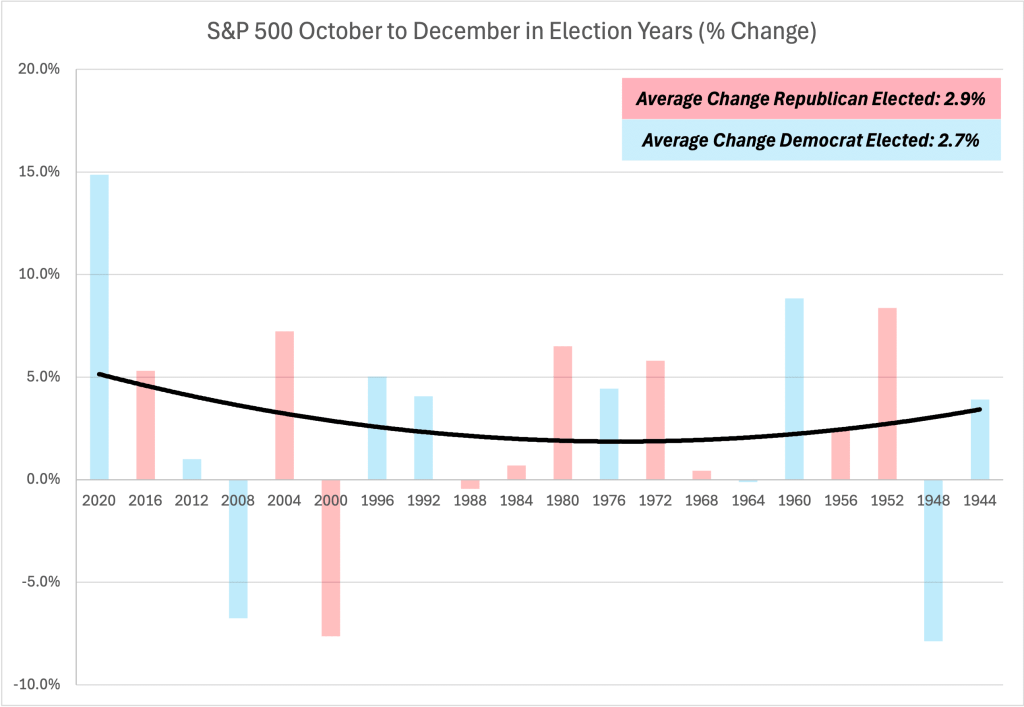
75% of the time, the market is up 2 months after the election.
2 out of the five times it was down, it was down by less than 1%.
With these returns, you have an 85% chance of being flat or better than when you started.
The last two elections that were down after were 2008 and 2000. These markets were already in decline for both (Great Financial Crisis and Dot Com Bubble). They were not caused by an election. The other was in 1948.
Conclusion: Pulling out of the market for fear of a market drop is risky!
How Does the Winning Party Impact Equities
Does it matter if democrats or republicans win? No.
The average two month return:
- Democrats: +2.7%
- Republicans: +2.9%
They both grow by about two and a half 3% regardless of who’s elected. The recent negative returns, again, were in 2008 and 2001. In one, a Republican was elected; in the other, a Democrat was elected. So, it doesn’t matter.
Conclusion: Pulling out of the market based on one outcome is risky!
Elections have no direct significant impact on the Equity Investing. We invest in businesses, not the government. Who leads the government shouldn’t change that. Stay the course.
So many the election doesn’t affect it. But surely the presidential term does.
The Power of Political Parties on Performance
How’s that for alteration?
Many think one party or another is the source of all good or bad returns. So, we’re going to show you a graph of the annualized S&P 500 returns by President for the last 20 terms.

I want you to notice a few things. A few things. Number one, it’s overwhelmingly positive. It doesn’t matter who’s in power. Businesses do well. They find a way. And number two, it looks fairly even by party, right? You can’t immediately see who does better or worse based on who’s in power.
Let’s look at it by performance on $100,000. What does it do to $100,000 over the course of a presidential term? Notice:
Presidential Term Performance

- One of each party doubled the money.
- 3 of top 5 are red, but 6 of the top 10 are blue
What about Inflation?
Inflation also plays a factor in this. $100,000 is not worth $100,000 by the end of any presidential term, let alone several of them. So, let’s adjust for it. And if we adjust for inflation, what are the real returns over the course of a presidential term?

It rearranges the leaderboard, but it still remains pretty. Even though Trump has the best returns, it’s followed by four Democrats, and Biden’s still going. So, he could also crack the top five by the time his presidential term is over.
Averages:
- Republican: 17%
- Democrat: 32%
Objections
These are not annualized returns. This is total return. But here’s the thing, if forecasts involve a story about tomorrow, then we also have to look at about stories about yesterday. We get a lot of objections by Republicans, when you just look at the numbers, just like that, right? Here’s a couple of them:
- Clinton presided over creating the.com bubble, and then at the end of the 90s then handed that off to Bush right during the collapse. So Bush was elected right at the top of the.com bubble burst, and so there’s a bunch of negative returns right there. And then he got hit on the backside by the global financial crisis, and neither of those was caused by the government, not by Clinton, not by Bush, so it’s just really bad timing. That’s why Bush’s returns are so terrible during his office.
- Obama entered office in January 2009, right before the market bottomed out in March. So, his first term was nothing but recovery from the bottom of the market to the top. And that is a real principle, right?
- We have to be careful about where we’re measuring returns from. That’s why I never like looking at since inception dates when comparing mutual funds. You can have the exact same fund that’s constructed the exact same way, and if it was created in January of 2007 versus January of 2009, there’s going to be a huge difference because it depends. One was measured from here; another one was measured from here.
And so, we so let’s say that we acknowledge these things, and we subtract them. So, let’s subtract Clinton’s second term, which created the bubble, or the bubble was being created during it. We’ll subtract both of Bush’s terms and we’ll subtract Obama’s first term.
The New Averages
- Republican: 25%
- Democrat: 25%
Conclusion: Aside from global catastrophes, the returns of presidential parties are even.
Still, the propaganda that Democrats are bad for the stock market is just plain wrong. When it comes to real returns, the returns of Democratic or Republican presidents are the same.
Beware of Propaganda
There are a lot of fears out there about one party winning or another, and if you have those or just ask who, who are you listening to? Right? The media can deceive you without ever lying to you. And they can do this in two ways. They can do this through volume, and they can do this through emphasis.
Volume of coverage
For example, CNN could say, “Biden had a memory slip this past week. But did you see how evil Trump is?” And they can spend 20 seconds reporting on Biden’s memory slip and 20 minutes reporting on all the shady stuff that Trump did.
On the other hand, Fox can say, “Trump had not a great tweet this week, but did you hear how evil Harris is?” And again, they spend 20 seconds reporting about something Trump did and 20 minutes reporting on what the other side did.
Just in the volume of what they cover, they can deceive you and make you think that one side is fine, and the other side is horrible.
Emphasis
Fox might say things like, “Here’s a ton of migrant crimes.” They’re just going to focus on that and make that a big emphasis of their broadcasting. And they totally disregard the fact that crime stats are falling.
CNN can make a big deal about the Republican tax cuts and how they’re making billionaires richer and cutting taxes for billionaires while ignoring the savings for the middle and lower classes.
So what they emphasize, even if they’re not actually lying about any of it, can make you believe one thing or another.
The Goal: Make You Fear the Other Side
And here’s the goal: They’re trying to make you fear the other side. They’re not trying to get votes for their side. They’re trying to make you vote against the other; they want you. Hey, maybe you don’t like your candidate, but we’re really going to make sure you hate the other one so that you vote for the lesser of two evils.
Informed or Brainwashed?
If you get all your news from one side, are you informed, or brainwashed. I contend you were willfully brainwashed. They are deceiving you without lying to you.
I recommend a 60/40 split: 60 on your side and 40 on their side. This is the minimum split to be truly informed and not brainwashed.
I’m probably 40/60. I know my positions, so I look for disconfirming evidence.
Or you could opt for a 0/0 split. Don’t listen to the news or politics at all. Review politician stances in the month leading up to the election and vote. Delegate the politics to the politicians and focus on your life.
Why Am I Talking About This?
You may ask me, why am I talking about this? Why am I? Why am I foraying into politics at all? And there are three reasons.
1. Focus on the Locus
There are two different ways that we can view life. You’re going to have an internal locus of control, where we think what we do has a big impact on our life, or an external locus of control, where we think our life is controlled by outside factors.
Your Locus of Control has a huge impact on your happiness and success. If people who are obsessed with politics often have an external locus, they believe that politicians who get elected and what happens in the election will have a massive impact on their lives.
The most politically minded people I know are the angriest and the most unhappy. On the other hand, people with an internal locus of control focus on their life, their family, their community, what they control, what actually matters, what they can influence, and they tend to be much happier.
Maybe if we all delegated more politics to the politicians, focused more on our own lives, and ignored the outrage machine that is the media and the news, we’d all be happier.
2. Fear is Not a Friend
Politics and media stoke fear. Fear of all kinds makes you a worse investor. So don’t let the stories of tomorrow and the other side drive you to fear, and let those drive your decisions because they will be bad decisions.
3. Don’t Stop the Symptom, Cut off the Cause
I’m here to help you be a better investor, right? I’m here to help you retire successfully and stay successfully retired. That’s the mission of this show. That’s the mission of my whole career. And politics and elections cause people to make bad investing decisions. We cover that in the Four Horsemen.
The Alternative
Rather than consuming the negative, outrage-inducing, fearmongering media, consume ours.
Join RetireMembership. It’s a weekly email or Podcast. Much of it is simply an antidote to negativity. Join for free—it’s always free.
In the meantime, Stay the course.
Want More? Become a RetireMember!
Get my book, 3D Retirement Income, for free, as well as access to live events, checklists and flowcharts, and wise counsel from one of the best minds in behavioral investing. Join today for free.
Need Help? Work with Me.
Schedule a Discovery Meeting with me through my Financial Planning firm, La Crosse Financial Planning. This no-cost, no-obligation conversation will determine what you are looking for and how we can help you retire successfully and stay successfully retired.
This article is educational only and is not intended to be investment, legal, or tax advice or recommendations, whether direct or incidental. Again, this is not investment advice. Consult your financial, tax, and legal professionals for specific advice related to your specific situation. Never take investment advice from someone who doesn’t know you and your specific situation. All opinions expressed in this article are those of the people expressing them. Any performance referenced is historical and is no guarantee of future results. All indices are unmanaged and may not be directly invested in.